* additional-week discount override $25 sibling discount. In other words, sibling discounts only apply to the first week. For example, a family with 2 children may register both for the first week and $25 discount is applied to that week. If they both register for an additional week, then the $25 additional-week discount is applied to each child, for a total discount of $50.
note: camp weeks with guest artists require a minimum number of registrants for specialized programming. Please contact for more details.
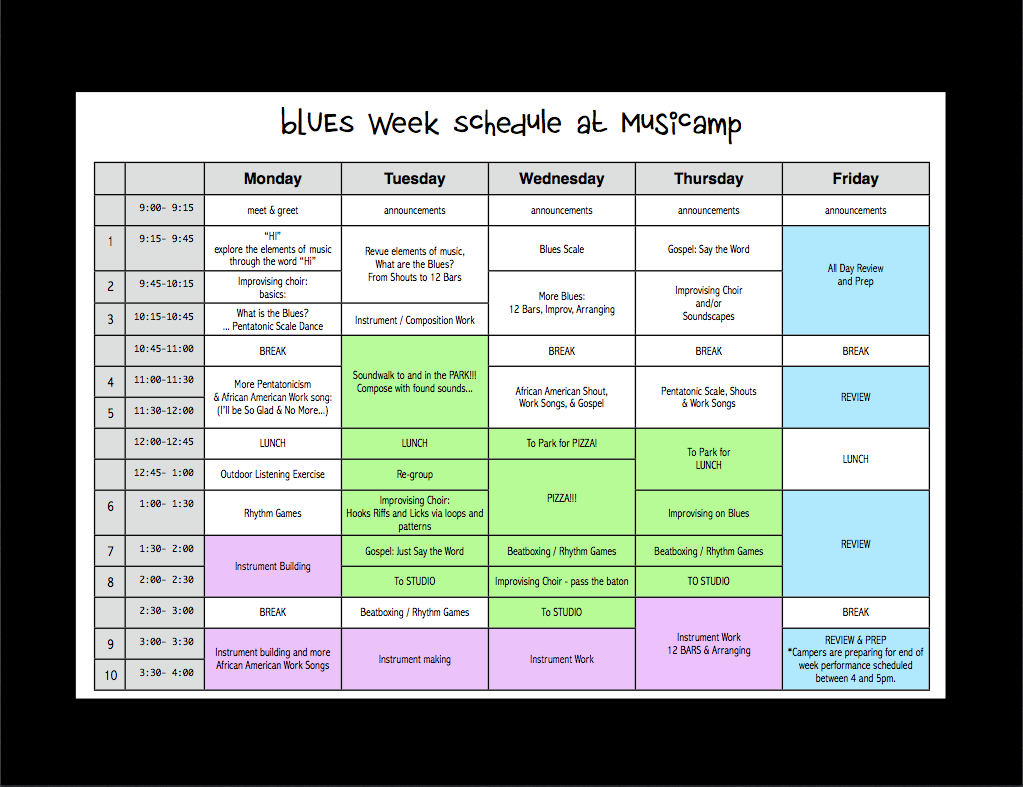
July 6 – 10 – The BLUES: FROM SHOUTS TO 12 BARS $225… more info →
July 13 – 17 – WEST AFRICAN DRUMMING (guest artist!) $275… more info →
July 20 – 24 – COMPOSITION & SONG $225… more info →
Aug 10 – 14 – WEST AFRICAN DRUMMING (guest artist!) $275…more info →
Aug 17 – 21 – ROOTS MUSIC (guest artist!) $275… more info →
Class sizes are small.
No formal training is required. No instrument required – just an enjoyment of music.
Our intuitive approach to exploring sound, music, composition, the voice, and the weekly themes also functions as a great supplement to conventional music lessons.
We also integrate crafts (instrument and mask making), backyard games, Pizza-making Wednesdays in Dufferin Grove park and other outdoor fun.
From great rock ‘n’ roll legends like Mick Jagger of the Rolling Stones, to pop divas like Beyonce or Katy Perry – they all know THE BLUES. And so should you!
Clapping on the off beats
Exploring the blues on the diddley bo
The blues progression
Blues is the root of all popular music and Blues Camp exposes campers to the rhythmic and melodic feels and harmonic frameworks of The Blues through groovy gospel tunes, African American shouts and work songs, the pentatonic scale as well as the blues itself – from its swingin’ roots to present day Soul and R&B.
And we’ll do this along with the tonne of musical games, beat boxing, body percussion and other fun-in-the-park activities we do every week.
Campers will:
build and compose on their own instruments (and explore some ideas about acoustics)
learn and improvise on the pentatonic scale, African American shouts, and work songs
vocalize the blues rhythms with beatboxing, feel the grooves with body percussion and hear the chord progressions with singing and instruments playing
write lyrics to, compose, improvise and sing over 12-bar blues and its derivatives.
While we do lots of vocal based activities, campers who already have instrumental experience are welcome to bring their instrument for this week and explore the blues instrumentally as well.
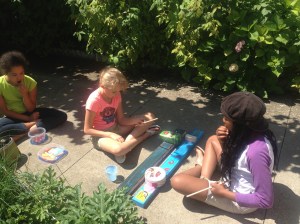
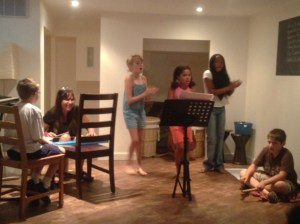
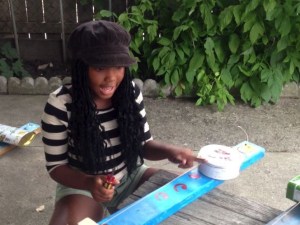
From the pictures above you can see some campers making diddley bos and bucket basses. The diddley bo is the precursor to the slide guitar and you click the picture below to see how bluesy it sound!. For more info on bucket basses click here.
Check out our Gallery for more pictures of previous camps!
Special guest artist for this week includes acclaimed singer / song-writer / banjo player / fiddler Hannah Shira Naiman!
Banjo instruction
Workshopping their instruments for the first time.
Making instruments
Ensemble practicing
End of week performance
Drawing from old time and Appalachian musics, bluegrass, shaped note singing, and other folk musics from North America as well as the English and Celtic traditions, Roots Music Week is all about group singing and playing folk songs. While there is always room for those who just want to sing, this week we welcome campers to bring their fiddle, guitar, ukulele, or banjo – or we can arrange the rental for those following a new found interest on one of these instruments. Guest artist co-leading the week is acclaimed singer/banjo/fiddler/song writer Hannah Shira Naiman, who happens to also be a professionally trained dancer, so there’s a chance we’ll also be doing a little jigging, clogging or square dancing! As we do in every week, we’ll also be making an instrument and visiting Dufferin Grove park for pizza days and other outdoor activity. The week will end with a coffee house style performance that parents and friends are invited to attend.
No previous training required. But those with skills on or ambition to play violin/fiddle, guitar, ukelel, or banjo will want to consider this week!
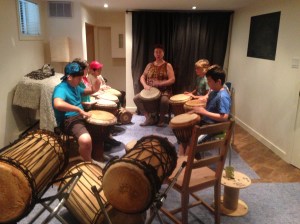
This slightly edited video is from our 2013 week-end performance of the children-composed rhythm “Timbaraba.”
Although it is difficult to see, at the back left are 3 double headed drums known as dunun. The dunun play a complex interlocking rhythm upon which the djembes play another rhythm or solo.
NOTE: Because the speakers of computers and portable devices aren’t designed to capture the bass, to hear the dunun pattern you need to listen to this video with headphones or good speakers.
As I mentioned in previous posts, MusiCamp was considering the possibility of campers making washtub basses as well as diddley bos this summer. So, this past Victoria Day my partner and I attempted to make a washtub bass.
For those of you who don’t know, a washtub bass is a one-stringed bass made up of a stick, a string, and an overturned washtub as the resonator (or better understood as what amplifies the sound of the plucked string).
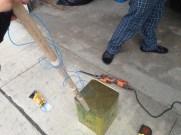
Tin olive oil container on left and 5 gallon plastic bucket on right.
We tried two different containers (the resonator of the instrument), two different strings, and a variety of playing techniques. While we quickly resolved what physical equipment (resonator and string) worked best, the playing techniques is clearly a work in progress ;) .
One container was a food-industry size oil container. It was metal and so I figured it would resonate more like a traditional washtub than the other alternative resonator, the 5 gallon plastic bucket. But the plastic bucket had a way fuller sound and the one we much preferred.
The two strings we tried was a cotton rope and a plastic weed-wacker line. We liked the rope more but it busted before we even got a chance to properly savour the sound. Luckily, the sound of the weed-waker line wasn’t dramatically different from the rope.
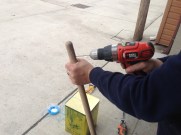
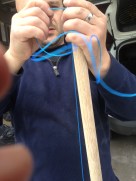
The construction simply involved taking a rake or broom handle, indenting a groove on one end and drilling a hole in the other. We also drilled a whole in the middle of the container/resonator. We then tied the one end of the weed-waker line to the container/resonator and the other end to the stick (which involved wrapping it around the stick a number of times and then securing it with duck-taped). Then we inserted the groove/indent on the rim of the bucket, the string becomes taught, and we started to twang away.
String attached to resonator
Drilling a hole in the broom handle
Stringing the stick up
Using a 5 gallon plastic bucket instead
I had assumed that playing different pitches/notes involved moving the stick back and forth; however, this seemed very difficult to keep in tune -as you can see in the youtube video below.
The playing technique that I soon adopted involved placing the stick a little closer to the centre of the bucket and using my fingers (usually just the index finger or the whole hand) to pitch the notes as well as moving the stick.
So, while I still need to work on the bass playing technique and possibly experiment with the instrument design to help secure the stick a little more (and thereby the intonation of the pitches/notes I play!) it is quite a simple thing to make and it makes a great bass sound!
Final say on the wash tub bass at MusiCamp? It’s definitely going to happen. I.e., if campers want to make one, it is very possible!
* additional-week discount override $25 sibling discount. In other words, sibling discounts only apply to the first week. For example, a family with 2 children may register both for the first week and $25 discount is applied to that week. If they both register for an additional week, then the $25 additional-week discount is applied to each child, for a total discount of $50.
note: camp weeks with guest artists require a minimum number of registrants for specialized programming. Please contact for more details.









 MusiCamp