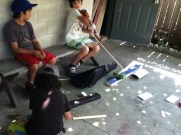
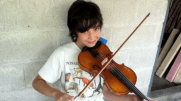
Surprisingly, I got the pics of the DIDDLEY BOs up earlier than I thought. Enjoy! By the way, exploring the acoustic properties of these instruments, we played with different resonators (a bottle for the instructor versus different size tins for campers), using a wooden block as a bridge or not, as well as the placement of the resonator. As you can see, campers were spectacularly creative in how they painted their diddley bos as well!
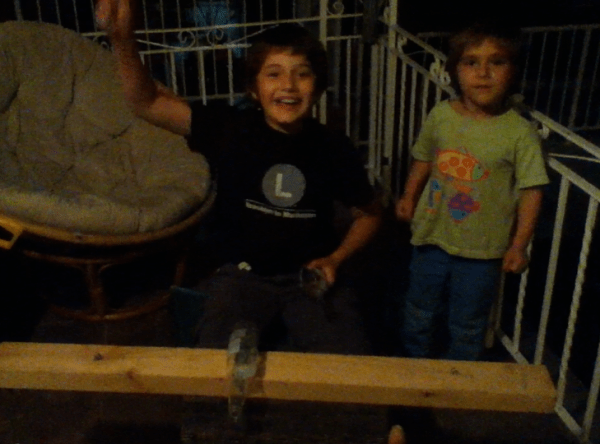
The video below (click the picture) demonstrates a MusiCamp homemade diddley bo, which is the precursor to the slide guitar and arguably the first blues instrument.
In a few days (or maybe a few weeks ; ) ), I’ll post the whole lot of diddley bos campers made at MusiCamp in its inaugural Blues Week!
click on the picture to hear what a didley bo sounds like
OUR SOUNDWALKS WILL WORK SORT OF LIKE A MUSICAL TREASURE HUNT!
And campers will use their found ‘sound’ treasures to construct their own soundscapes, following their own inspirations and creative instincts.
One of the things we’ll be looking at every week are soundwalks and soundscape compositions. But what are these? Before I tell you more about these things, have a listen to the following soundscape composition called “City Symphony” from the movie August Rush – a film about a young orphaned prodigy who uses his musical gifts to find his biological parents.
Soundwalks
Soundwalks are exactly what they sound like: walks that explore sound. You can explore the sounds everywhere – whether it’s deep in the forest of the Toronto Ravine system or in the commercial semi-industrial space behind Dufferin Mall. But what’s really interesting about sound walks is how much more you are able to see when you take the time to listen. Often soundwalks can even uncover hidden stories about a place or a neighbourhood…
Soundscapes
“A soundscape is any collection of sounds, almost like a painting is a collection of visual attractions,” says internationally renown Canadian composer R. Murray Schafer. “When you listen carefully to the soundscape it becomes quite miraculous.”
There are soundscapes that occur organically from our natural or urban environments – that’s what the composer R. Murray Schafer is talking about above. And then there are composed soundscapes.
This piece of art is actually the musical score written by world-renown Canadian composer R. Murray Schafer. The instrumentation involves an orchestra, 7 singers, and electronic sounds.
Soundscape Compositions
Soundscape compositions are compositions that rely less on what we usually expect from music, like a regularly repeated melody and/or rhythm. Instead, it explores sounds and silence, and is more directly inspired by a specific idea and/or emotion. Often this results in a musical piece that boarders on theatre or performance art. You can even see from the picture (which is an actual score by the composer R. Murray Schafer) how the score of a soundscape composition defies conventions and looks more like a piece of art than the typical musical notation.
at MusiCamp
As mentioned, at MusiCamp, our soundwalks will work like a musical treasure hunt and campers will be:
instructed to search for specific types of sounds
encouraged to connect the dots between what they hear and what they see to makeup a story about the place or neighbourhood they acoustically explore.
Back at the studio, campers will:
create a soundscape composition imitating the sounds they heard – perhaps to tell the story of the place or neighbourhood they just explored
and if campers wish to, they will also be given the opportunity to create their own score for their creation
During the West African Drumming Week, we’ll be exploring the Mande musical tradition – more of which can be read (and seen in videos) just below this introductory section on the history of Mande drumming.
In 1235, the Mande warrior king named Sunjata Keita rose to power and united many kingdoms in West Africa to establish the Mande empire and what would be a 200-year golden age of peace and prosperity in the region.
Musicians at this time were more than just musicians. They were highly valued as negotiators, praise singers and historians. This history and its musical tradition lives on in a large part of west African countries, including Mali, Guinea, Gambia, Senegal, Ivory Coast, Burkina Faso, and Guinea Bissau as well as parts of Nigeria, Sierra Leone, and Liberia.
By the way, the story of Sunjata Keita is incredible since he was born a cripple and was exiled from his home because of this. Yet, he not only overcame his disabilities but established the prosperous Mande empire. More youth-oriented information can be read here: http://www.africa-junior.com/en/youth/knowledges/sundiata-keita.html.
.
How MusiCamp Will Explore Mande Music
Guest host AnnA Melnikoff , with her expertise in the Mande drumming tradition, will guide us through this week’s activities. She’ll be bringing her exquisite drums which include djembes and a set of 3 bass drums called dunun. Each dunun has its own pattern which overlap with one another to form a melody upon which djembes can solo. In this week, you’ll get a chance to learn the various dunun patterns, djembe accompaniment patterns as well as a group djembe solo.
Focusing on rhythms that accompany rights of passage, participants will also build masks and explore the meaning of the drums and the rhythms from the very ancient Mande tradition.
Check out the videos below to get a sense of what we’ll be playing in the West African Drumming Week!
An Idea of Mande Drumming in Videos
SOUNDS OF MANDE DRUMMING
The 3 drummers standing are playing the dunun – the smallest drum is called the kenkeni, the middle drum is called the sangban and the largest drum is the dundunba. The guys sitting are playing 2 different accompaniment patterns on djembes.
THE SOUND OF THE DJEMBE
This one the drum instructor is demonstrating the 3 different tones on the djembe – tone, slap and bass, or in French “ton,” “claque,” and “bas” . By the way, French is spoken in many West African countries.
THE SOUND OF THE DUNUN
This video starts with a pattern on the middle dunun drum known as the sangban. Then the kenkeni (the smallest drum) is introduced. Note it is the simplest of all the 3 drum patterns but has the most important role of keeping the beat steady. Finally the bass drum, the dundunba, is introduced.
Rather then try to explain what are circle songs, have a look at this video “Bobby McFerrin Spontaneous Chorus.”
This performance is like a collection of circle songs. Bobby McFerrin sings a little repeated melody (an ostinato) and hands it over to a group of singers. Then he creates another melody/ostinato and hands it to the next group of singers, and so on, all the while he may also be soloing (making up a melody) on top of the groove the singers are keeping. By the way, all the singers are most likely not a rehearsed chorus but just audience members who just volunteered to go up on stage.
The approach to circle songs at MusiCamp is not that much different than what you saw in the video. Of course, we won’t be on stage and we’ll start off with very simple melodic patterns and some rhythmic ones as well. And depending on the group, the circle songs can develop musically from there. The wonderful thing is you don’t need to be an amazing singer to create this collective, groovy fun music. Also, campers who wish to explore their soloing abilities will be given that opportunity. Whether they want to scat, howl , make rhythmic noises, or invent a language – the groove set up by the rest of the group gives them an opportunity to explore solo expression in a safe and supported environment. I’m really looking forward to this!
The camp is located in a newly renovated studio in a private home on a quiet cul-de-sac close to Dufferin Mall (Dufferin and Bloor, see the map to your right).
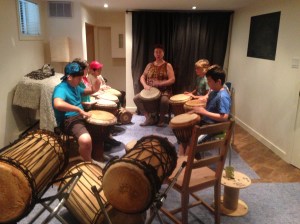
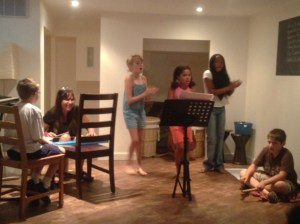
Below are Flickr galleries of the indoors and outdoors from our 2013 summer music camps.
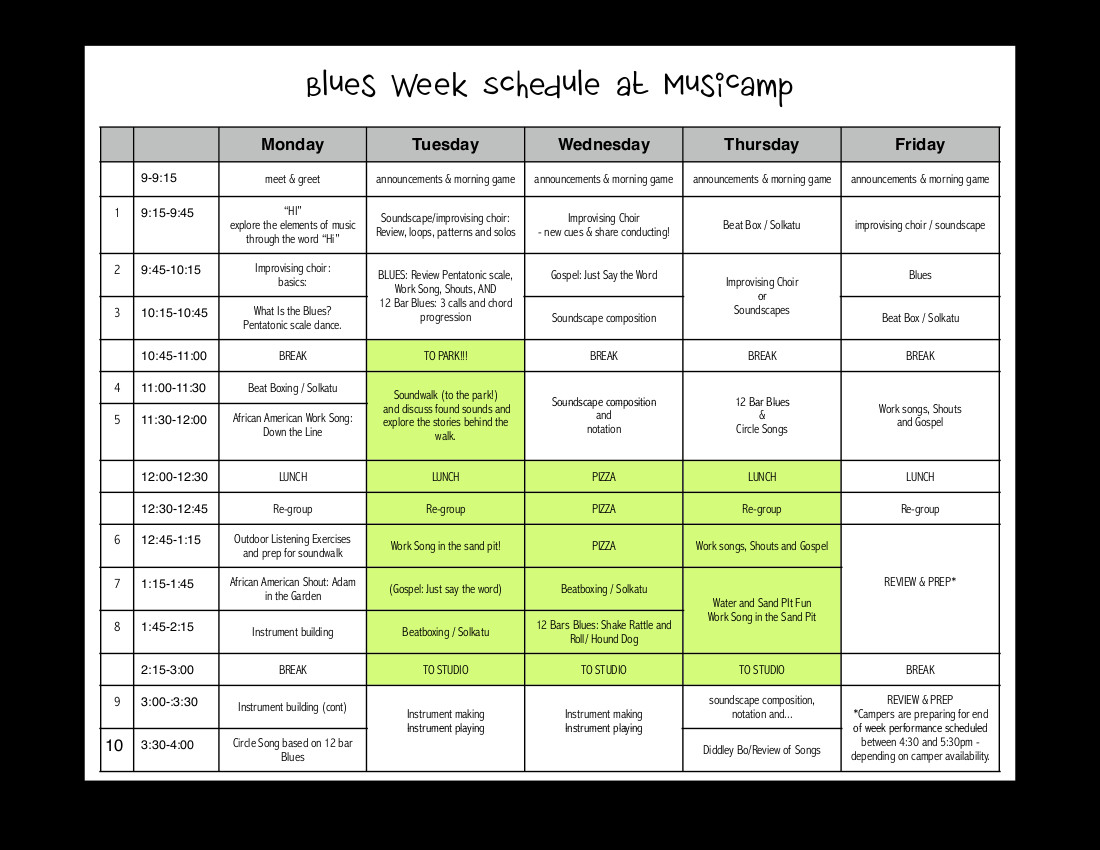
MusiCamp is a summer day camp experience that explores music making in a positive environment, filled with activities that build your child’s musical skills in an intuitive and fun way. The activities are designed to supplement traditional formal musical training but also be accessible to the less experienced music enthusiasts. Weekly themes like The Blues, Singer-Songwriter or West African Drumming provide musical direction to the week, which is further supplemented with craft making (instruments and masks) and stories that broaden the child’s cultural and historical understandings of music and society. It all culminates in a end of week performance to which parents and friends are welcomed to attend.
No instrument needed. No formal musical training. All that’s need is a love for music, the willingness to explore the voice in all its beauty and rawness, and the readiness to be a part of an exciting and affirmative team!






 MusiCamp
